




Plasma Technology in a Hair Dryer: How Does It Work and What Does Ionization Do?
Ionization tames static, plasma goes one step further. Anna Nowak-Ibisz explains in plain words what these technologies do for your hair, whether they are harmful and when they make sense.

Over more than a decade on the TV show Pani Gadżet, hundreds of devices with "ionization" printed on the box passed through my hands. And I'll be honest with you: for a long time I myself couldn't explain what that label actually promises. This is Anna Nowak-Ibisz, co-founder of SkinVibe. Today I know this topic inside out, because ionization and plasma are the heart of our hair dryers - and that is exactly why I want to explain it to you the way I once wanted to hear it myself: in plain words, without quantum physics and without marketing fog. What these technologies really do, how they differ, whether they are safe and when it makes sense to go for them.

IN SHORT
- Ionization in a hair dryer means emitting negative ions that neutralize electrical charges on your hair: less frizz, less static, a sealed cuticle and more shine.
- Plasma technology goes one step further: it emits negative and positive ions at the same time, so on top of taming static it also supports moisture, volume and the structure of the hair.
- Neither ionization nor plasma is harmful - it's pure physics, not chemistry. What threatens your hair is excessive temperature, not ions.
- A paradox from search data: every month around 6,400 searches look for a hair dryer "with ionization", while around 1,550 ask what it even is. We buy the slogan on the box.
- Good ionization is enough for most hair. Plasma makes sense for very frizzy, color-treated and dry hair.
What does ionization do in a hair dryer?
Ionization in a hair dryer neutralizes the electrical charges that build up on your hair while you dry it. The dryer emits negative ions, and they discharge the static strands: the hairs stop repelling each other, frizz less and seal the cuticle more easily. In practice this means smoother, calmer and shinier hair - without a single extra product. I write about static itself, meaning where the charge on your hair comes from and why winter is the worst, in a separate article about static hair.
Where does this static come from in the first place? Wet hair rubbed by a stream of air becomes electrically charged, like a balloon rubbed against a sweater. Charged strands push each other away, and that's where the familiar effect comes from: fluff, "flyaway" hair and what people on forums have been calling straw or a bird's nest for years. Negative ions simply cancel out that charge.
There is one condition hardly anyone talks about: you have to feel ionization, not read about it. The effect depends on how many ions actually reach your hair, and the differences between devices are huge. In our Libra AirLoom, ionization means 200 million negative ions per cm³ - a dose you can see on your hair after the first drying, not in a spec table.
And to be fair, I'll add something you won't read on the boxes: the effect of ionization is not permanent. Ions neutralize charges while you dry, so the smoothness lasts until your hair builds up static again - from a hat, a brush or dry winter air. Then you renew the effect the next time you dry your hair. That's normal physics, not a flaw of the device.
The ionization paradox: we pay for a feature we don't understand
When we were analyzing search data while working on the brand, one thing kept bugging me. Every month around 6,400 searches on Polish Google are about hair dryers "with ionization" - someone wants to buy one, here and now. And at the same time around 1,550 people a month type in questions like "what does ionization do in a hair dryer" or "what does ionization mean". For every four people who want to pay for ionization, there is roughly one who is only just checking what it is.
The scale is all the more striking because in Poland a hair dryer is a mass purchase: for most of the year the Polish phrase for "hair dryer" is searched around 50,000 times a month, and in December that number almost doubles - last winter it reached nearly 92,000. So we buy a lot, often as a gift, and very often we go by a slogan on the box that nobody has ever explained to us.
I don't hold it against you - for years manufacturers treated "ionization" like a magic spell you only have to print on the packaging. I'd rather you knew what you are paying for. Hence this article.
Plasma technology: one step further than ionization
Plasma technology differs from ionization in one detail, but a key one: it emits negative and positive ions at the same time. Ionization tames static - plasma does the same, and on top of that it supports moisture, shine and the structure of the hair, because balanced charges seal the cuticle and help keep moisture inside. An extra effect is more volume.

In our Aurea Family x Plasma hair dryer, a plasma emitter placed at the air outlet generates one billion positive and negative ions per cubic centimeter of air. These bipolar ions instantly neutralize the charges that build up during drying, and the hair settles like the surface of calm water - with no extra straightening. Plasma is also the subject of scientific research, including in the context of hair health, although this is still a young field of research.
What does this mean in numbers? In our comparative measurements of Aurea, plasma translated into hair elasticity higher by 138.5%, shine by 65%, strength by 42% and color retention better by 49%. In practice: hair breaks less when you detangle it, holds its color longer after dyeing and shines so much that your friends ask you about it.
| Ionization | Plasma technology | |
|---|---|---|
| Which ions | Negative only | Negative and positive at the same time |
| Main effect | Less frizz and static, a sealed cuticle, smoothness and shine | The same, plus moisture, volume and an effect on the hair structure |
| Who it's for | Most hair with moderate static | Very frizzy, color-treated, dry hair |
| In our devices | Libra AirLoom: 200 million negative ions per cm³ | Aurea: one billion positive and negative ions per cm³; Astra straightener: over one million per cm³ |
One important caveat, because honesty is fundamental to me: plasma is not a must. It's an optional top-shelf technology - our Aurea has it, but good ionization is completely enough for most hair. I'll come back to this at the end.
Is ionization in a hair dryer harmful?
No. Ionization and plasma do not change the chemical structure of the hair - they neutralize electrical charges on its surface. It's the same physics that charges a balloon rubbed against a sweater, just working the other way: instead of charging, it discharges. Once you switch the dryer off, nothing is left on your hair except the effect - smoothness and a sealed cuticle.
I understand where this worry comes from: "ions" sound like something from a laboratory, and we know and protect our hair. But if you are looking for side effects, you will find them somewhere else entirely: in excessive temperature, not in ions. It's hot air - especially when held close to one strand - that really damages hair. Dermatologist Marcin Zakrzewski recommends airflow at a maximum of around 70°C; trichologists point to similar limits. That's why in Aurea we set the warm airflow to 55°C, and a sensor checks the temperature a hundred times per second.
I've described the drying technique itself - distance, direction, the order of steps and the cool finish - separately in my guide on how to dry your hair properly. Ionization and plasma complement good technique, but they won't replace it.
What plasma looks like in practice: our Aurea Family x Plasma
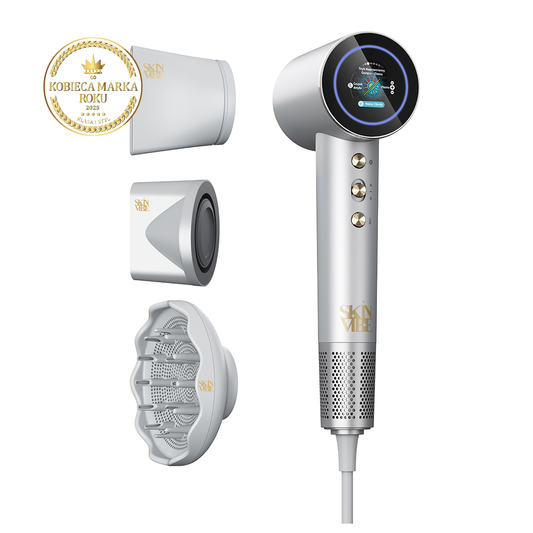
Plasma technology is easiest to show with an example, and I have the best one at hand - our Aurea Family x Plasma plasma hair dryer. In it, plasma works together with a brushless motor running at 110,000 revolutions per minute, which generates an airflow of up to 25 m/s. In practice: short hair dries in around 29 seconds, long hair in 5-7 minutes, and the shorter hair stays wet and heated, the less it gets damaged - speed is care, too.

After you click, YouTube (Google) plays the video.
Around plasma we gathered everything that, over years of testing devices, I came to see as non-negotiable: seven modes (from constant temperature, through alternating warm-cool cycles, to modes for children and pets), three magnetic nozzles that rotate 360°, including a wave diffuser, operation at a maximum of 59 dB and a weight of 410 grams. There's also my favorite detail: the touch sensor. The dryer runs while you hold it and pauses when you put it down - when you are detangling sections, that changes everything.

We also used plasma in our Astra SteamPlasma straightener - there it emits over one million positive and negative ions per cm³, a smaller dose than in Aurea, matched to plates working on dry hair. I say this openly, because numbers deserve a fair comparison.
And the most common skeptical comment I read? "I had a hair dryer with ionization and didn't feel a thing." I believe it. That's exactly why, instead of promising you magic, I give you ion counts and the results of our measurements - whether you can feel a technology starts with the dose and ends on your hair, not on the box.
Aurea is no longer the only plasma hair dryer in our family. In summer 2026 it was joined by Nova PlasmaGo: a mini hair dryer weighing 310 g, with a brushless motor of the same rotational speed as in Aurea, plasma of the same dose as in Aurea (one billion positive and negative ions per cubic centimeter of air) and a noise level of 59 dB. It was designed with travel and small bathrooms in mind: it comes with a concentrator but no diffuser, so for curls I still suggest Aurea or Libra. Whether a small hair dryer makes sense at all, and for whom, I've covered in my guide on travel hair dryers.
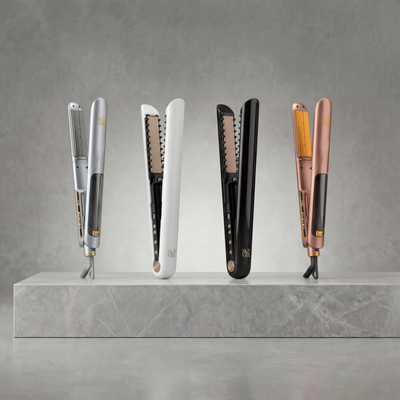
Our Nuvia AirPlasma hot air styler has plasma too: 400 million positive and negative ions per cubic centimeter work with each of the seven attachments, including the curling barrels and brushes, so hair frizzes less during styling as well.
Plasma or ionization: which should you choose for your hair?
I'll answer the way I answer my friends. If your hair has moderate static and you simply want smooth, calm drying - good ionization is completely enough and there's no point paying extra for plasma. If your hair is very frizzy, color-treated or dry - plasma will make a difference you'll see in the mirror, not just in the specs. If after this answer you already know that ionization is enough for you, I've described in a separate guide how to choose a hair dryer with ionization and which numbers to look at.

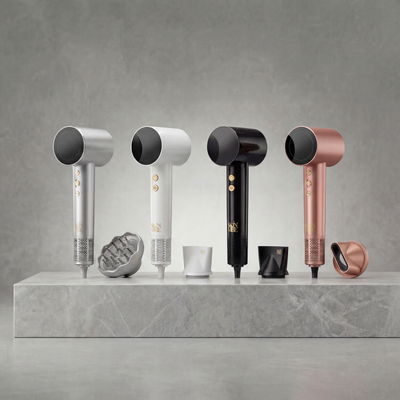
You'll find both technologies in one collection, where SkinVibe plasma hair dryers sit next to Libra with ionization, and you can compare the models side by side on the comparison page. You can also take a shortcut: the 90-second matching quiz will point you to the model for your hair. If you are only just choosing a device and want to go through all the parameters one by one - from the motor, through noise level, to the nozzles - I've written a whole guide on it, how to choose a hair dryer. And if after reading something still doesn't add up - write to us, we read every message. Good technology is the kind you can feel on your hair, not the kind you see on the box. 🤍
Anna Nowak-Ibisz, co-founder of SkinVibe
Frequently asked questions about ionization and plasma
What does it mean when a hair dryer has ionization?
It means that while drying, the device emits negative ions that neutralize the electrical charges building up on your hair. As a result, hair frizzes less and builds up less static, the hair cuticle seals more easily, and strands are smoother and shinier. The strength of the effect depends on the number of ions emitted, which can differ between devices by orders of magnitude.
What is ionization in a hair dryer?
Ionization is a hair dryer feature that, while blowing air, sends negative ions onto your hair, that is, air particles with an electrical charge. It comes from a small emitter at the air outlet, not from the temperature or the motor power. These ions neutralize the positive charge that hair collects while drying, which is why after drying with ionization strands are smoother and frizz less.
What does ionization do in a hair dryer?
It does three things at once: it discharges static hair, helps seal the hair cuticle and shortens drying, because ions break water droplets into smaller ones. You see the effect right away: less fluff, more shine and hair that doesn't stand away from your head after you take off a hat. The strength of this effect depends on the number of ions, not on the mere presence of the feature in the description.
Is ionization in a hair dryer harmful?
No. Ionization neutralizes electrical charges on the surface of the hair and does not change its chemical structure - it's a purely physical phenomenon. What is harmful to hair is above all a drying temperature that is too high; dermatologists recommend airflow up to around 70°C. In this equation, ions are on the side of protection, not risk.
How many ions does a plasma hair dryer emit?
Our Aurea Family x Plasma generates one billion positive and negative ions per cubic centimeter of air - that is the specification of the plasma emitter placed at the air outlet. For comparison: Libra AirLoom with standard ionization emits 200 million negative ions per cm³, and the Astra SteamPlasma straightener over one million ions of both charges per cm³. Nova PlasmaGo has an emitter with the same dose: one billion ions per cubic centimeter of air, half positive and half negative.
Does plasma work on color-treated hair?
Yes, and it's precisely on color-treated hair that you see it fastest. Balanced ion emission seals the hair cuticle and helps keep moisture in, and in our comparative measurements color retention came out 49% better. The condition is the same as always with color-treated hair: dry at a moderate temperature.
Is it worth paying extra for plasma instead of ionization?
It depends on your hair. For hair with moderate static, good ionization does the job and plasma isn't necessary. Paying extra makes sense for very frizzy, color-treated and dry hair - there, bipolar ion emission delivers an effect that ionization alone can't: better moisture, more shine and longer-lasting color.
Can you really feel ionization in a hair dryer?
Good ionization - yes. After drying, hair is noticeably smoother, calmer and doesn't crackle when you detangle it. If you don't feel any difference with your hair dryer "with ionization", it most often means the ion dose is too small, not that the technology doesn't work. Whether you can feel it starts with the number of ions that actually reach your hair.
Is ionization in a hair dryer the same as cool air?
No, these are two independent features. Cool air is a stream of room-temperature air that you use at the end of drying to seal the cuticle and set your style. Ionization is the emission of ions that neutralize electrical charges, and it works regardless of whether you dry with warm or cool air. In a good hair dryer these features complement each other: ions smooth while you dry, and the cool finish sets the effect.


